TechSov4Futures at Cyborg Workers 3.0: Exploring Social Dialogue’s Role in Digital Sovereignty
TechSov4Futures at Cyborg Workers 3.0: Exploring Social Dialogue’s Role in Digital Sovereignty
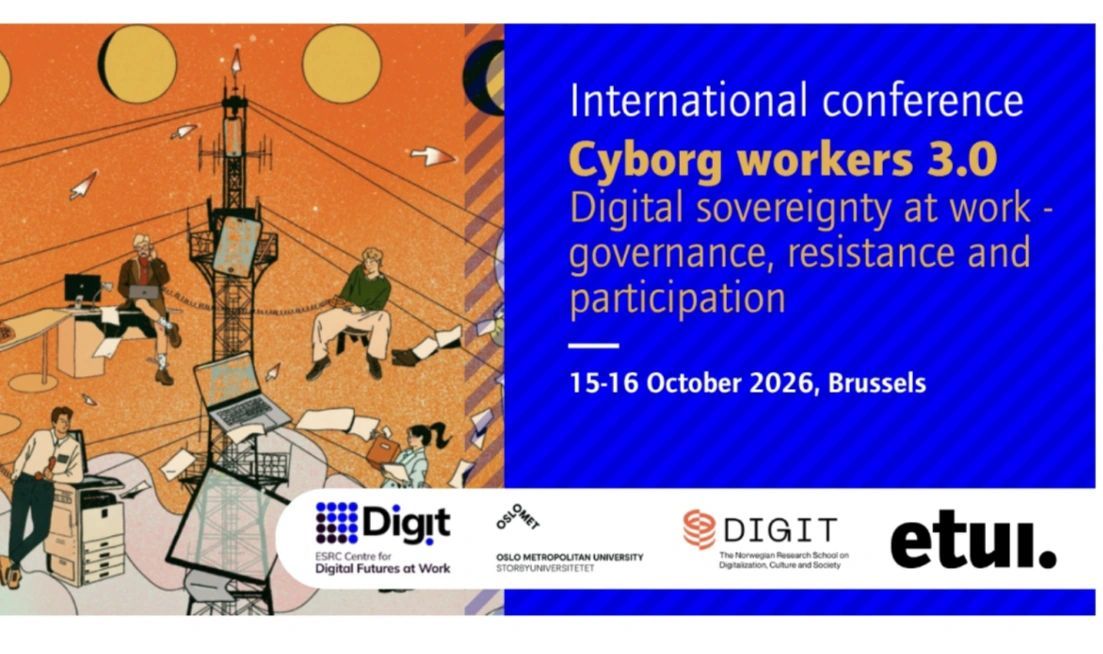
TechSov4Futures – Social Dialogue for Digital Sovereignty at the workplace contributed to the international conference Cyborg Workers 3.0 – Digital sovereignty at work: governance, resistance and participation, held in Brussels on 15–16 October 2026. Diletta Porcheddu, researcher at Fondazione ADAPT, presented the project’s research framework and preliminary findings in her contribution, Digital Sovereignty and Social Dialogue in Europe.
The conference brought together researchers and practitioners to examine how digital technologies are reshaping work, with particular attention to governance, participation and control. Organised by the European Trade Union Institute (ETUI), the Digital Artificial Intelligence Symposium (DAISY), and the Norwegian Research School on Digitalisation, Culture and Society (DIGIT), in collaboration with the Cyborg Workers Collective, it provided a relevant setting for discussing the questions at the heart of TechSov4Futures.
The project’s contribution focused on a practical question: what opportunities do employers, workers and their representatives have to influence technological change? Moving from European debates on technological autonomy to strategic decisions within companies, the presentation explored how social dialogue can help shape the adoption and use of digital technologies and their consequences for working conditions, skills and work organisation.
Specific attention was paid to small and medium-sized enterprises (SMEs). Interviews suggest that their room for technological choice depends on both internal capabilities and market demands. Employers’ organisations can play an important intermediary role, helping articulate these challenges and connect business needs with institutional decision-making.
The presentation also explored the potential of social dialogue to support a more participatory digital transition. Information, consultation, collective bargaining and joint training can help employers and workers anticipate organisational change, discuss concerns and develop shared approaches to new technologies.
At the same time, the preliminary findings of the research phase of the project point to barriers that require further attention, including limited AI-related expertise among social partners, the relatively low presence of technological issues in collective bargaining, and difficulties in assessing the impact of new technologies before their introduction. These findings reinforce the importance of equipping social partners with accessible knowledge and practical tools for discussing digital transformation.
Participation in Cyborg Workers 3.0 offered an opportunity to share this emerging evidence with an international research community and place the project’s work within wider debates on digital sovereignty and workplace democracy. It also helped strengthen connections between the project’s research and interdisciplinary discussions on how technological change can be governed.
These exchanges will inform the continuing research and the development of scientific outputs, alongside the project’s planned capacity-building activities in Italy, Albania, Hungary and Spain and at European level. Through these activities, TechSov4Futures will further explore how social dialogue can give employers, workers and their representatives meaningful opportunities to shape the digital transition.